Dog Agility Terms and Obstacles Explained
New to agility? The sport has its own language. This glossary explains the obstacles, handling moves, and training words you will hear in class, in plain terms. You do not need to know any of them before your first lesson.
Agility Obstacles
The equipment your dog will meet on an agility course.
- Bar JumpAlso called: hurdle, single jump
- Two upright posts with a light bar across them. The bar falls if the dog touches it, so the jump is safe. Beginners start with the bar on the ground or set very low.Read what age dogs can start agility
- Tire Jump
- A ring hung inside a frame. The dog jumps through the middle of the ring instead of over a bar.
- Double JumpAlso called: double, spread jump
- Two bars set one behind the other at the same height. The dog clears both in a single jump, so it has to jump long as well as high.
- Triple JumpAlso called: triple, spread jump
- Three bars set one behind the other, each a little higher than the one before. The dog clears all three in a single jump. It is the longest of the bar jumps.
- Panel Jump
- A jump made with solid panels instead of bars. It looks like a low wall, so the dog cannot see through it.
- Wall Jump
- A jump built to look like a solid brick wall. Loose blocks sit along the top and fall off if the dog touches them, the same way a bar would.
- Broad JumpAlso called: long jump
- A set of low, flat boards laid on the ground. The dog jumps across all of them in one stride without stepping on them.
- Wings
- Side panels attached to a jump that make it wider. The dog still goes over the bar in the middle, but the handler has to move around the wings.
- TunnelAlso called: open tunnel
- A flexible tube, about two feet wide, that the dog runs through. Tunnels come in different lengths. Beginners and puppies start with a short, straight tunnel so they can see the way out. Competition tunnels are usually 10 to 20 feet long, and the longer ones can be bent into a curve so the dog cannot see the exit. Many dogs learn the tunnel quickly and it often becomes a favorite.
- Weave PolesAlso called: weaves
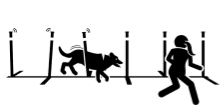
- A straight line of upright poles, usually six or twelve. The dog enters with the first pole at its left shoulder and bends in and out of every pole without skipping one. This is the hardest obstacle to teach and takes the longest to learn.See how weave pole training fits into your first six weeks
- Contact ObstaclesAlso called: contacts
- The A-frame, dog walk, and teeter. The dog climbs on, crosses, and comes down, touching the painted zone at the bottom.
- A-Frame
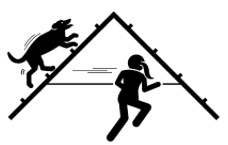
- Two wide ramps joined at the top to make an “A” shape. The dog runs up one side and down the other.
- Dog Walk
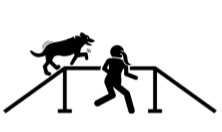
- A long, narrow plank raised off the ground with a ramp at each end. The dog goes up, across, and down.
- TeeterAlso called: seesaw
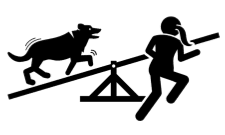
- A plank balanced in the middle. The dog walks up, the plank tips, and the dog rides it down to the ground before stepping off. Dogs learn the movement and the sound in small steps.
- Contact ZoneAlso called: the yellow
- The painted section, usually yellow, at the bottom of each contact obstacle. The dog must touch it with at least one paw. The rule keeps dogs from leaping off from too high up.
- TableAlso called: pause table
- A low, square platform. The dog jumps on and holds still for a short count before running on. It teaches control in the middle of the excitement.
Handling Terms
The words for how you move and guide your dog around the course.
- Handler
- The person running the course with the dog. In agility, that is you.Learn how dogs and handlers work together in agility
- Team
- One dog and one handler working together.
- Handling
- The way you use your voice, arms, shoulders, and position to show your dog where to go next.
- Cue
- A word or body signal that asks your dog to do something, like “tunnel” or a pointed arm.
- LineAlso called: dog’s path
- The path the dog runs between obstacles. Good handling gives the dog a smooth, clear line.
- Front Cross
- A change of sides where the handler turns toward the dog and crosses in front of the dog’s path. The dog switches from one side of you to the other.
- Rear Cross
- A change of sides where the handler crosses behind the dog after sending it ahead to an obstacle.
- Blind Cross
- A change of sides where the handler moves ahead of the dog and switches sides without turning to face it. For a moment the dog is behind your back.
- Lead Out
- Walking ahead onto the course while your dog waits at the start line, so you begin the run in a better position.
- Send
- Cueing your dog to go ahead to an obstacle on its own while you stay back or move somewhere else.
- Wrap
- A tight turn around one upright of a jump, so the dog comes back toward the direction it came from.
- Backside
- Taking a jump from the far side. The dog runs around the jump first and then jumps back toward the handler.
- Threadle
- Bringing the dog in between two obstacles and back out again to take the next one from the same side as the last.
- Serpentine
- Three or more jumps in a row that the dog takes in an S-shaped path, changing direction over each one.
- Pinwheel
- Three or four jumps set in a curve, like the spokes of a wheel. The dog runs the outside while the handler stays near the middle.
- Collection
- The dog shortens its stride to jump tight and turn. The opposite of extension.
- Extension
- The dog opens up into long, fast strides on a straight line. The opposite of collection.
- Obstacle Discrimination
- Two obstacles set close together, such as a tunnel opening under the A-frame. The dog has to pick the one you cue.
Training Terms
Words you will hear in class as skills are taught and practiced.
- Foundations
- The early skills taught before full obstacles: focus, body awareness, following the handler, and simple low equipment.Explore our beginner and puppy agility classes
- Start Line Stay
- The dog waits calmly in front of the first obstacle until you give the release cue.
- Release Cue
- The word that tells your dog it may move, such as “okay” or “break.” It ends a stay or a stop on a contact.
- Marker
- A short word like “yes,” or a click, that tells the dog the exact moment it did the right thing. A reward follows.
- Lure
- Using food in your hand to guide the dog through a movement. The lure is faded out as the dog learns the skill.
- Target
- An object, such as a small mat or lid, that the dog learns to touch with its nose or paws. Targets help teach where to stop on a contact.
- Two On, Two OffAlso called: 2o2o
- A way to finish a contact obstacle. The dog stops with its two back feet on the ramp and its two front feet on the ground.
- Running Contact
- A contact performance where the dog runs through the contact zone without stopping.
- Channel Weaves
- A way to teach weave poles. The poles are set in two offset rows with an open path down the middle. The rows are brought closer together as the dog learns.
- Weave GuidesAlso called: guards, guide wires
- Light barriers attached to the weave poles that help guide the dog along the correct path while it is learning.
- Weave Entry
- Finding the correct first gap in the weave poles. The dog must enter with the first pole at its left shoulder, from any angle.
- Sequence
- A short string of obstacles practiced together. Sequences are the step between single obstacles and full courses.
- Proofing
- Practicing a skill with new distractions, places, or handler positions so the dog can do it anywhere.
- Drive
- A dog’s eagerness and speed while working. Trainers build drive with play and rewards.
Class and Competition Terms
Helpful to know if you watch a trial or decide to enter one. Competing is always optional.
- Course
- The full set of numbered obstacles the team runs in order. The layout is different every time.
- Course Map
- A drawing of the course showing each obstacle and its number.
- Walk-ThroughAlso called: course walk
- The time before a class runs when handlers walk the course without their dogs to plan their path.
- Run
- One team’s turn on the course.
- Trial
- An agility competition. Teams run courses in front of a judge and are scored on faults and time.See our competition agility training
- Ring
- The fenced or marked area where the course is set up.
- Judge
- The person who designs the course and signals faults during each run.
- Fault
- A mistake that costs points, such as a knocked bar, a missed contact zone, or a wrong obstacle.
- Refusal
- The dog stops, turns away, or hesitates in front of the correct obstacle before taking it.
- Run-Out
- The dog runs past the correct obstacle instead of taking it.
- Off CourseAlso called: wrong course
- The dog takes an obstacle out of order or from the wrong direction.
- Clean Run
- A run with no faults, finished within the time allowed.
- Standard Course TimeAlso called: SCT
- The time allowed to finish the course. Going over it adds time faults.
- Qualifying RunAlso called: Q, leg
- A run that meets the standard for that class. Qualifying runs count toward titles.
- Title
- An award a dog earns after a set number of qualifying runs at a level. Titles are added to the dog’s registered name.
- Jump Height
- The height the bars are set for your dog. It is based on the dog’s height at the shoulder, so small and large dogs compete fairly.Find out whether agility is right for your dog
- Standard
- A class that uses every type of obstacle, including the contact obstacles and the table.
- JumpersAlso called: Jumpers With Weaves, JWW
- A faster class made mostly of jumps and tunnels, usually with weave poles, and no contact obstacles.
- LevelsSuch as: Novice, Open, Excellent, Masters
- Steps of difficulty in competition. Teams start at the first level and move up as they earn qualifying runs.
- Agility OrganizationsSuch as: AKC, USDAA, CPE, NADAC, UKI
- The groups that write the rules and run trials. Each one has its own classes, levels, and jump heights.